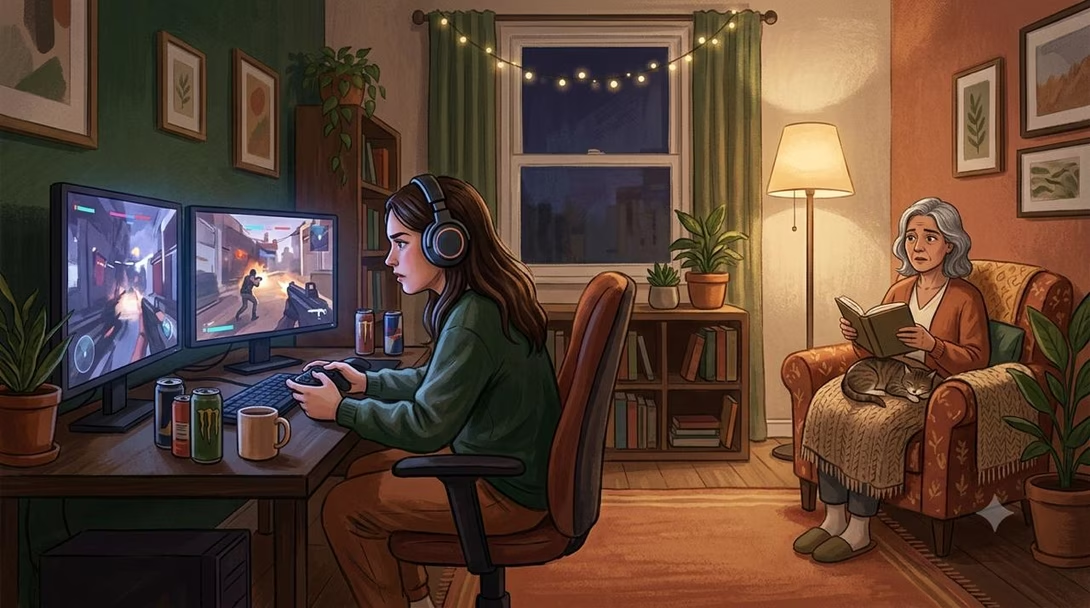
Video game addiction: when a hobby stops being just a hobby
Games are fine. They are a way to rest, to stay in touch with friends, to feel competent in a place where life is not offering much competence. The number of hours on its own tells you very little. The question is not how much you play, but what happens to the rest of your life while you do.
Where the line runs
The international classification of diseases (ICD-11) includes a diagnosis called gaming disorder. There are three key features, and they persist not for a couple of weeks but for around a year:
- Loss of control. You cannot decide when to start and when to stop. "One more match" turns into four hours, and it happens almost every time.
- Gaming crowds everything else out. It consistently ends up mattering more than sleep, food, study, work, seeing people — not because you chose it that way, but because it cannot go otherwise.
- Continuing despite consequences. There are already problems at work, conflict at home, damaged health — and still nothing changes.
One important note: a diagnosis is made by a clinician, not by an article or an online test. But if you recognise yourself in these points, it is worth looking into regardless of the formalities.
What this does not mean
Playing a lot is not the same as being dependent. Someone who spends a weekend gaming and then goes to work on Monday, sleeps, sees friends and can stop when they need to is simply absorbed in a hobby. What separates a hobby from a dependency is not intensity but freedom: you still have a choice about whether to play.
And this: dependency is not about weak willpower. Games are built to hold attention — that is their designers' job. Unpredictable rewards, visible progress, daily quests, a social obligation to your team — all of it works through the same mechanisms as other forms of dependent behaviour. Being ashamed that it worked on you makes about as much sense as being ashamed that you were sold a well-designed product.
What usually sits underneath
In my practice, the game itself almost never turns out to be the problem. It turns out to be the solution to some other problem — just a solution with a high price.
- Anxiety. A game has clear rules and predictable outcomes. Reality offers neither, so you want to go where things are calmer.
- Loneliness. A raid or a voice channel gives you a sense of belonging that is missing away from the screen.
- No sense of moving forward. Nothing has changed at work for years, while a game shows clear progress: a level, a rank, something achieved in an evening.
- Depression and burnout. When there is no energy for anything, a game is often the only available source of any emotion at all.
- Avoidance. There is a conversation, a task or a decision that feels too frightening to touch. Gaming lets you postpone it indefinitely.
That is why simply deleting everything and "pulling yourself together" usually fails. If you remove a way of coping without putting anything in its place, the anxiety and the emptiness do not disappear — they get louder.
What you can do
1. Look at the data, not at your impressions
For a week, note it down: how long you played, how you felt before starting, and how you felt an hour afterwards. It often turns out that the pull is not boredom but something specific — a difficult conversation, a failure, the end of a workday you had to force yourself through.
2. Work out what the game actually gives you
Excitement? A sense of mastery? Company? The chance to think about nothing? The answer tells you what to add in the rest of your life. A need for company will not be met by a schedule and a timer — it will be met by real contact.
3. Change the setup, not your willpower
Agreements work better than bans: play after certain things rather than before them; decide the number of rounds in advance; turn off autostart and notifications; move the console out of the bedroom. The point is not punishment — it is that the decision gets made at a moment other than the one where stopping is hardest.
4. Bring back what was crowded out, one piece at a time
Not "start a new life", but restore one specific thing: sleep at a normal hour, one walk, one meeting with a person each week. Recovery comes not through giving something up but through gradually returning what the game replaced.
5. Don't wage war on yourself
There will be slip-ups. They are part of the process, not proof that you are hopeless. "I sat there until three again, so it's all pointless" is exactly the thought that guarantees the next such night.
If it is someone close to you
Rows, unplugged cables and ultimatums usually backfire: the game becomes territory that has to be defended. What works is different — talking about what you see and what you feel, without diagnoses or accusations: "I notice that we barely talk any more, and I miss it." And taking an interest in the game itself: what happens there, what makes it so absorbing. That is not approval — it is a way of staying in contact, without which no change is possible.
If it is a teenager, remember that the game is often the one place where they feel successful and part of a group. Taking that away without offering anything in return is not a solution.
When to see a professional
If you have already tried several times to limit yourself and it has not worked. If study, work, relationships or health are suffering because of it. If without the game things feel so anxious and empty that you go back simply to avoid feeling that. If thoughts have appeared that everything would be easier without all of this.
Cognitive behavioural therapy works well with dependent behaviour: we look at which situations and thoughts trigger the urge to play, at what it gives you, and at how to get that another way — by adding rather than taking away. You can start with a free 20-minute intro call: tell me how things are, and we decide together where to begin.